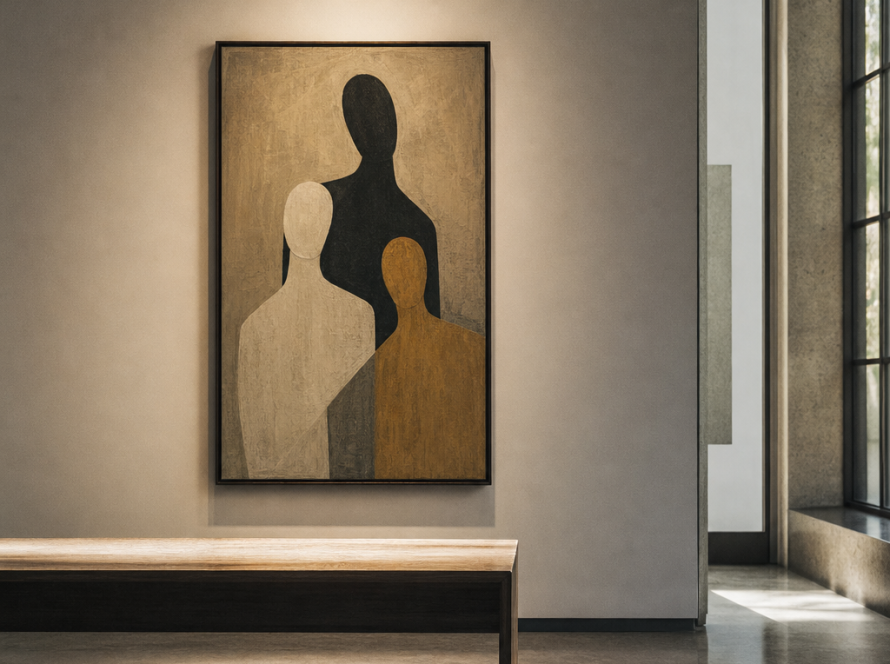
A photograph on a gallery wall: a woman, reclining, eyes averted, her body arranged with a precision that borders on choreography. The composition is elegant, the lighting soft, the intent—at first glance—ambiguous. Is this an act of self-possession, a moment of vulnerability, or a careful performance for an audience? The room is quiet except for the slow shuffle of visitors, each pausing, weighing their own role as both observer and participant. What, exactly, are we meant to see?
The phrase “male gaze” slips into art criticism as easily as a lens cap sliding from a camera. It evokes a way of looking—a structure of desire, power and expectation—that shapes not only how women are depicted but how all bodies are positioned within the frame. In painting, in photography, in film, the male gaze is both an idea and an atmosphere: sometimes visible as a directorial hand, sometimes as subtle as a whisper beneath the surface. Yet the term itself can feel loaded, even blunt, threatening to flatten a diverse array of artistic gestures into a single axis of gendered looking. Still, it persists, woven through the history of images that promise pleasure, provoke discomfort, or slip between the two.
To explain the male gaze through art is not to accuse every artist of voyeurism, or to turn every nude into a political statement. Instead, it is to notice how certain habits of looking—often unconscious—have shaped not only who is seen but how we are asked to see them. The result is a tangle of complicity and resistance, desire and critique, a set of questions that refuse easy answers. Why does the gaze matter, and what happens when artists, viewers and subjects push back?
The male gaze matters because it is not merely about who holds the camera or brush but about which desires are legitimized, which stories are told, and which bodies are offered up for scrutiny or worship. Its influence lingers in the smallest compositional decisions and in the expectations viewers bring to the act of looking. Yet, as art changes, so too do the contours of the gaze, raising new questions about authorship, agency, and the shifting politics of desire.
The male gaze shapes how we see, what we expect to see, and—crucially—what remains invisible in art. Its power lies in both its ubiquity and its slipperiness, altering not just who is seen but how we are taught to look.
What Is the Male Gaze?
The term “male gaze” gained currency in the late 20th century, popularized by film theorist Laura Mulvey to describe a mode of representation in which women are objectified for the presumed pleasure of a heterosexual male viewer. In fine art, this idea manifests in countless nudes painted, sculpted or photographed by men, with the female body posed for visual consumption. The gaze is not limited to obvious eroticism; it finds expression in the subtle arrangement of limbs, the angle of a shoulder, the softness of a glance. It is an attitude, a structure of power, a set of visual expectations that shape how we read bodies in art.
The Gaze in Practice: Between Artist and Subject
Consider classic works—the odalisques of Ingres, the bathing women of Renoir, the sensual photography of the 20th century. Each invites the viewer into a scene, but rarely on neutral terms. The subject is often presented as available, passive, beautiful in accordance with certain ideals. Yet some works resist: Olympia by Manet returns the gaze of the viewer with a frankness that unsettles, while contemporary artists play with, subvert or reclaim the mechanics of looking. Even when the image appears familiar, the relationship between artist, subject and audience is never static. It is always negotiated, sometimes consciously, sometimes through inherited habits.
Technology, Intimacy and the Contemporary Gaze
The proliferation of cameras and screens has only complicated the landscape. Where the classical gaze was bounded by the studio or the salon, digital media offer new possibilities and new risks. In works such as Peter Adams’ The Digital Female Nude, the act of photographing the body becomes both an exploration and a question: Is the subject collaborating or performing, consenting or conforming? The very tools of representation—lenses, filters, editing software—invite artists and viewers to reconsider who is looking, and why. This is not just about men looking at women, but about the structures that continue to shape what we find desirable, acceptable or worthy of attention.
Desire, Discomfort and the Act of Looking
To look at art is to risk discomfort, particularly when desire is at stake. The gaze can seduce or repel, sometimes both at once. For some viewers, awareness of the gaze sharpens pleasure; for others, it complicates or even poisons it. The history of erotic art is filled with images that oscillate between fantasy and critique, beauty and exposure. Recognizing the gaze does not mean abandoning pleasure, but it does demand a more nuanced, self-aware encounter with images and the histories they carry.
Yet the male gaze is not a monolith. Labelling every depiction of the body as a product of male desire risks missing acts of resistance, self-invention and ambiguity. Many women have painted, photographed or sculpted themselves and others, sometimes reproducing familiar tropes, sometimes overturning them. Queer artists, too, have complicated the binary of subject and object, exploring desire and identity through alternative ways of seeing. The gaze, in this sense, is not only “male” but a shifting field—contested, reimagined, sometimes inverted. Some works consciously court the gaze, others disrupt it, and some simply refuse to play by its rules. The line between looking and being looked at is never steady.
Understanding the male gaze in art begins with noticing how images are composed, whom they privilege, and how power circulates between artist, subject and viewer. The next time you encounter a painting, photograph or sculpture—especially one depicting the body—pause to consider: Who is present, and who is implied? Is the subject passive or engaged? What assumptions guide your own looking? Works such as Peter Adams’ The Digital Female Nude can serve as case studies, inviting viewers to examine not only the image but the act of seeing itself. By tracing the gaze, we do not strip art of its pleasures; instead, we learn to appreciate the complexities and contradictions that have always been part of looking, and being looked at.
Back in the gallery, the reclining figure remains as she is: unhurried, composed, her gaze turned elsewhere. The crowd moves on, but the questions linger, suspended in the quiet tension between artist, subject and observer. In this moment of stillness, the act of looking is no longer invisible. It is part of the art itself.