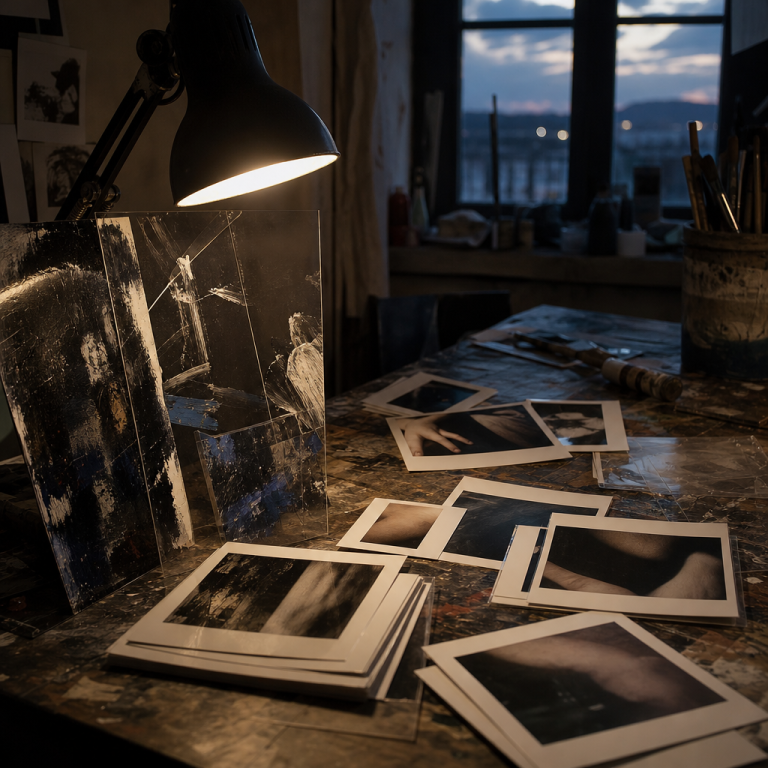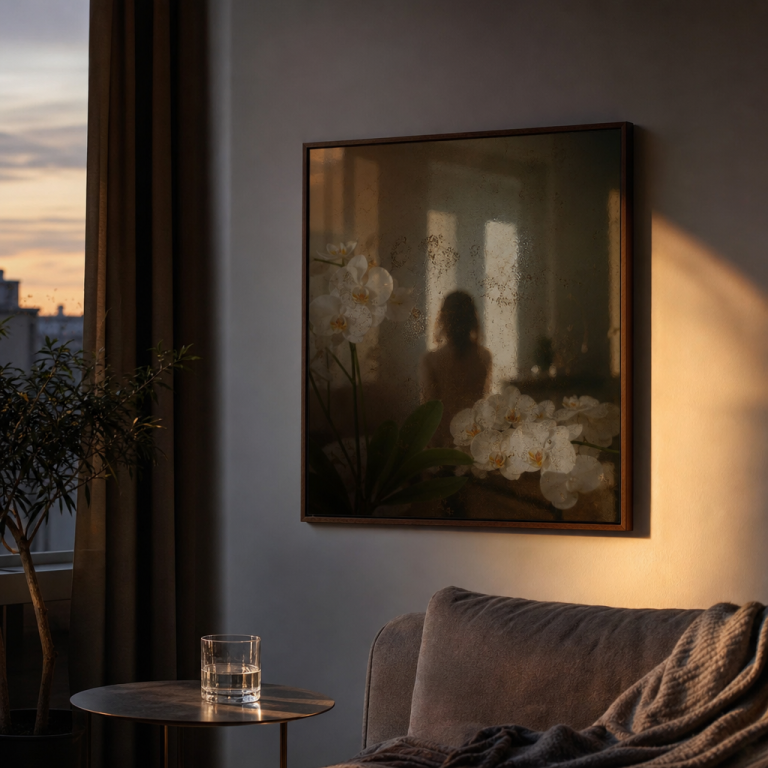

A sunlit living room, carefully arranged. On one wall, an abstract canvas in cool mineral tones. On a shelf, a small bronze figure—stylized, ambiguous, polite. In the adjacent hallway, a door remains closed, not for lack of space but for discretion. Inside, propped against an unpainted wall, a drawing of two bodies, arms woven together, their outlines both vulnerable and unmistakable. The glass is unframed, the paper slightly curled. It is not shame that keeps the work out of sight, but something more intricate: the sense that not every image needs to meet every gaze, even in a home built for openness.In the world of erotic and intimate art, the boundary between what we display and what we keep private is rarely fixed. The question is not merely what is ‘appropriate’ or ‘tasteful,’ but whom we allow to see what, and why. A painting that feels at home in a private bedroom might feel exposed in a hallway. A photograph that provokes conversation in one context may be quietly set aside in another. Our choices are rarely about the artwork alone; they are about the shifting choreography of bodies, eyes, and thresholds within private space.What does it mean to choose visibility for one artwork and discretion for another? The answer is not found in a universal standard, but in the subtle interplay of desire, vulnerability, memory, and context. The art we display and the art we hide reveal, as much as any image itself, the contours of our own private rituals.
The question of which artworks we display and which we hide is more than a matter of style or embarrassment. It reflects how we negotiate intimacy, privacy and self-exposure inside our own spaces. Erotic art, in particular, often sits at the threshold of these negotiations, holding a mirror to our ambivalence about looking and being seen.Our hesitation to display certain works does not always signal shame; sometimes, it is an act of care, a way of protecting both the artwork’s meaning and our own boundaries. This quiet choreography is what gives private collections—and private rooms—their unique rhythm.
The Living Arrangement of Images
Homes are not galleries. The arrangement of art within private spaces is shaped less by curatorial logic than by the lived choreography of everyday encounters: family, friends, lovers, strangers. Each artwork, especially those with erotic charge, is considered not just for its formal qualities but for the kinds of conversations—or silences—it might provoke. The decision to hang a piece in the living room or to leave it in a closed drawer is a reflection of both personal taste and social negotiation.In practice, many collectors rotate their displays. Some works emerge only when certain guests visit, others are quietly tucked away when children or unfamiliar acquaintances are present. The artwork itself accrues layers of memory, secrecy, and anticipation with each movement between hiding and display.
Intimacy, Vulnerability and the Erotic Image
Erotic art carries a particular weight. A piece such as Paul Muresan’s ‘Peeping Tom’, with its atmosphere of observation and steam, raises questions of permission and proximity even before it is hung. The image of an intimate moment, rendered with ambiguity, may feel both inviting and uncomfortably exposed, depending on where it resides. The framing, the height on the wall, the room itself—all become gestures of trust or reserve.Unlike overtly explicit works, which draw boundaries by their very directness, subtler erotic pieces invite the viewer to complete the scene. This ambiguity demands a different kind of discretion—one that is not about censorship but about recognizing the shared vulnerability of looking and being looked at.
Thresholds and Private Spaces
Doors, corridors, alcoves and screens serve as practical and symbolic thresholds in the home. The placement of erotic art often mirrors these transitions. A drawing that feels too raw for the foyer may find its place inside a walk-in closet, a study or behind a curtain in the bedroom. The act of hiding an artwork is not necessarily a denial; sometimes, it is a way of preserving a feeling or a memory for oneself or for a chosen other.For more on how intimacy and secrecy are constructed in art, see this exploration of privacy in artwork.
There is a risk in romanticizing secrecy. Hiding an artwork can reinforce the notion that certain desires or bodies are inherently ‘unshowable,’ feeding cycles of shame. Yet, forced visibility can flatten the personal meaning of an image, turning private resonance into awkward spectacle. The line between protection and suppression is delicate, and it shifts with our relationships, our moods, even with changing daylight. What we conceal today may be displayed tomorrow, and vice versa. The choreography of visibility is never finished.
To display or to hide is not a binary choice. Consider the rhythms of your daily life, the qualities of each room, and the thresholds—literal and emotional—that shape your space. Let the artwork’s mood, material and gesture guide its placement: a drawing suffused with quiet tension may belong in a place of retreat, while a piece with more playful energy might suit a gathering space. Trust the pauses between display and privacy; these intervals can deepen an artwork’s resonance rather than diminish it. Above all, remember that the visibility of erotic art is an ongoing negotiation, not a test of openness or taste.
Later, the sun has shifted. The closed door is now ajar, and the drawing inside is caught by a ribbon of afternoon light, its outlines momentarily visible between shadow and threshold. Private, but never quite hidden. The choreography continues, quietly composing the private theatre of the home.