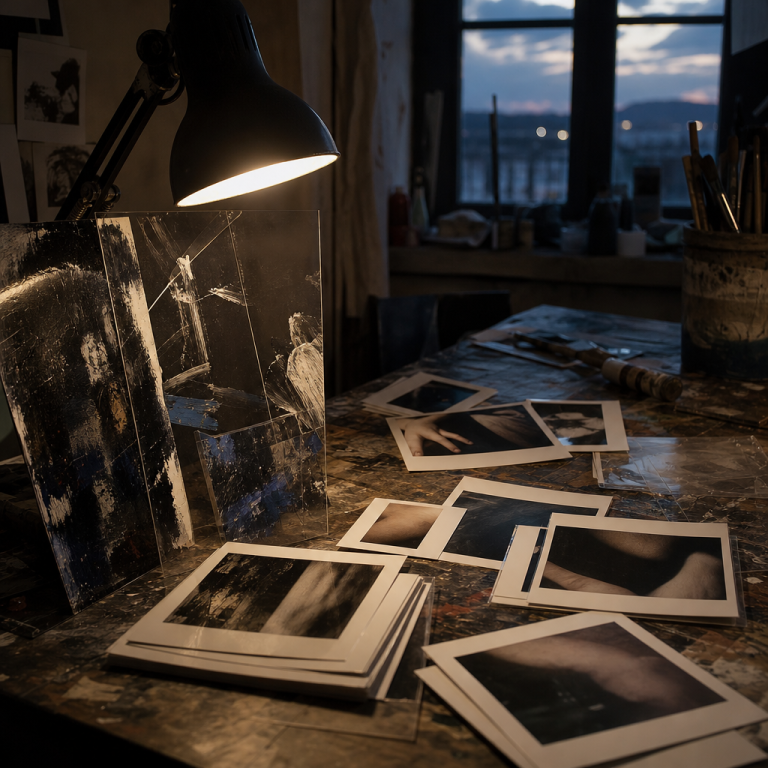

A living room, early evening. A guest’s eyes land on a graphite drawing, minimal and ambiguous, hung with deliberate care above a bookshelf stacked with paperbacks. Elsewhere, a vivid print leans against a wall, its lines enigmatic but charged, while a solitary ceramic object—strange, hand-formed—sits atop a sideboard. Each piece, whether framed or resting in a gentle state of arrival, seems to tell a fragment of a story: about its maker, certainly, but also about the person who placed it here, who chose to bring it into this specific space. What compels someone to collect a particular artwork—especially one that edges toward the erotic or the intimate? Is it a declaration, a secret, a provocation, or simply a private pleasure? The art we collect rarely answers these questions in plain language. Instead, it acts as a coded autobiography, as much about what we wish to encounter as what we wish to reveal—or conceal—from others.
Consider the difference between a room filled with conceptual sketches and one dominated by bold, figurative bodies; between those who prefer the whisper of suggestion and those who embrace the gaze directly. The choices, often made with impulsive affection or careful intention, create a silent portrait of taste, vulnerability, curiosity and the risks we are willing—or unwilling—to take. What, then, does your art collection say about you, whether you mean for it to speak or not?
To treat an art collection as mere décor is to overlook its deeper register: as a map of private thresholds, questions, and desires. The works we choose make visible the values, risks and pleasures we are willing to live alongside. They are not only about art, but about self-presentation, privacy and how we navigate between them.
Your art collection is less a mirror than a series of hints. It discloses sensibility, curiosity, and your comfort with ambiguity or exposure—sometimes in ways you may not anticipate or control.
Reading the Room: Art as Self-Disclosure
For as long as collectors have displayed art, the act has been both a form of self-expression and a negotiation with the gaze of others. The placement of a particular drawing, sculpture or photograph becomes a statement—sometimes quiet, sometimes unmistakable—about what matters to the collector. Where one person might relish the wry ambiguity of Maria Brudașcă’s Brutalist, another might gravitate to direct, corporeal forms, or the playful tension of wearable art. These preferences speak to how each person calibrates intimacy, discomfort and curiosity in their surroundings.
Collecting as Curiosity—and Control
The very act of collecting erotic or intimate art often reflects a willingness to admit complexity, to live with objects that do not resolve easily into simple categories. Some collectors are drawn to ambiguity, preferring works that disclose less at first glance—a line drawing that asks more questions than it answers, a photograph that leaves the narrative deliberately incomplete. Others embrace explicitness, seeing in bold, figurative works a directness that feels honest, unafraid, or even liberating. Yet, even the boldest statement piece can be positioned to reveal or shield, depending on where it is placed, how it is lit, who is invited to see it.
The Social Life of Artworks
Artworks exist not only as objects, but as participants in the rituals of daily life. A collection may be curated for the self, for an inner circle, or for strangers and guests. The choices of what to hang and what to store, what to display openly and what to keep private, are themselves acts of curation. The social context of a collection—whether it is a wall of portraits in a bedroom, a single drawing in a hallway, or a rotation of pieces for different moods—shapes not only how others see us, but how we see ourselves. In this sense, the art we live with forms a living archive of evolving desire, taste and memory.
Yet, the meaning of an art collection is never stable. Works that once felt daring may grow familiar, while pieces acquired as quiet companions may later seem unexpectedly confessional. What a collection says about its owner can change with each new encounter, guest or phase of life. The collector’s intent is only part of the story—interpretation belongs just as much to the viewer, whose own projections and histories color every encounter. There is, too, the risk of misreading: a piece hung in jest might be received in deadly seriousness, or a private indulgence mistaken for provocation. The collection’s language is always incomplete, its sentences unfinished.
To understand what your art collection says about you, look first at how you live with it, not just what you own. Notice what you choose to show and to whom, which pieces you move when company is expected, which ones you keep close. Consider what remains unresolved or ambiguous, and what feels essential. The most revealing collections are rarely the loudest or most complete—they are the ones that make space for both comfort and friction, for both the known and the mysterious. Taste is not a fixed identity, but an ongoing negotiation, visible in every object you select, place and revisit over time.
As evening settles and the room grows quiet, the shapes on your wall and the objects at hand remain: less as declarations, more as reminders of what you choose to live alongside—and what you allow to remain unsaid.